
Almost without fail, when discussing rail accessibility, politicians and rail industry leaders remind us that much of the UK rail network was constructed in the Victorian era. Guys, this excuse is wearing thin after 150-plus years. ‘Glacial’ is probably the best description of the rate of progress towards a step-free railway and this shows no sign of improvement under the current Labour government.
Access for All – a very brief history
Access for All funding, a ring-fenced budget for rail accessibility improvements, was launched by a Labour government in 2006. This funding was aimed at creating an obstacle-free, accessible route from the station entrance to the platform, usually through the provision of lifts or ramps. Since 2006, step-free access has been delivered at around 270 railway stations in the UK. Below is a table showing the funding levels for Access for All between its inception in 2006 up to 2029.
| Dates | Details |
| 2006-2014 | £390 million – a confirmed figure from various sources. |
| 2015 – 2019 (Control Period 5) | £132m or £160m depending on source. However, £50m of this was deferred until the next Control Period as a result of the Hendy Report – 12 stations had their funding deferred as a result. |
| 2019-2024 (Control Period 6) | £350m plus £50m from the previous Control period, total £350m. |
| 2024 – 2029 (Control Period 7) | £350m as per the May 2024 announcement. This has been touted as an ‘HS2 dividend’ but I believe this is just the usual AfA spend, not an additional £350m on top. |
| *Please note these are funding announcements, not an indication of what was actually spent. | |
| 2024 – 2029 (Control Period 7 as amended by the new Labour government) | Up to £280 million. |
Funding for the railways has traditionally been allocated in five-year ‘Control Periods’, and in the case of ‘Access for All’ funding, this has always led to a bit of a bun-fight between competing railway station accessibility campaigns before each Control Period, with relatively little activity in the intervening years. Therefore, for every successful campaign, such as the one for Biggleswade station in April 2019, there would be an unsuccessful bid, as seen with Flitwick, which failed to receive funding in 2019, but was subsequently awarded funding via the March 2020 budget.
Tory ‘Access for All’ Funding Announcement
Fast-forwarding to May 2024, in the last days of the Conservative government, an announcement was made that 50 stations had been selected for “initial feasibility work.” If successful, these stations would be provided with up to £350 million of Access for All funding for Control Period 7 (2024-2029). Below is an excerpt from the Conservative government’s ‘Network North – Transforming British Transport’ document published in October 2023.
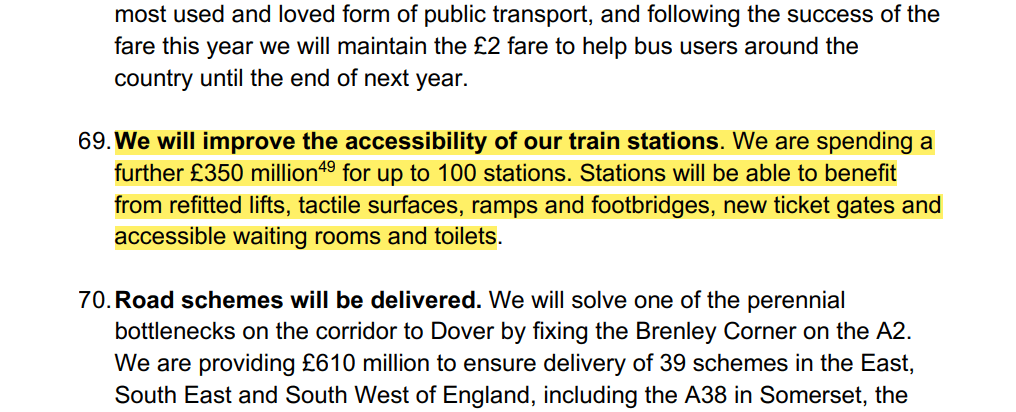
Note 49 indicated that this £350 would be coming from ‘existing budgets’ rather than an HS2 axing dividend. Of course, the Conservative government was voted out of office less than two months later and things were left in the air about what was to happen next. You can see the list of 50 stations here: https://www.gov.uk/government/publications/railway-stations-awarded-access-for-all-accessibility-funding/railway-stations-awarded-access-for-all-accessibility-funding
July 2024 – Labour in Power
The new Labour government’s promise of change was tempered by a very downbeat opening few months, where expectations were dampened at every turn. As I wrote in late July 2024: “I have yet to see any firm commitment to accelerating progress toward a step-free rail network. A step-free rail network is not just morally the right thing to do; it also makes good financial sense, with a guaranteed healthy return on investment. Furthermore, it aligns with many core values and missions of the Labour Party, including equality, social justice, access to work and leisure, and the drive towards net zero.”
August 2024 – However, as Keir Starmer talked about rail accessibility in August 2024 as a “basic requirement”, there was hope that a more enlightened approach would be taken.
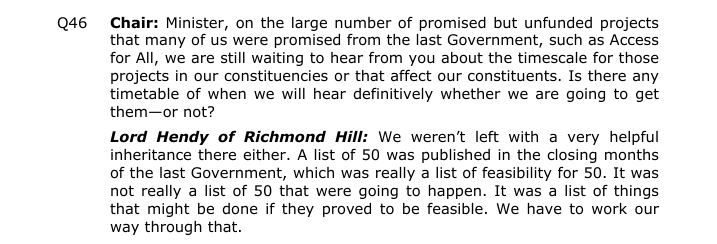
December 2024 – We see the first signs of backtracking from the Labour government, with Lord Hendy stating that the (50 stations) “was not really a list of 50 that were going to happen”. This would have been eyebrow-raising news for the communities around the 50 stations mentioned.
March 2025 – Kate Dearden MP confirms that 29 of 50 stations had completed their feasibility studies, with the remaining estimated to be completed by the Summer of 2025.
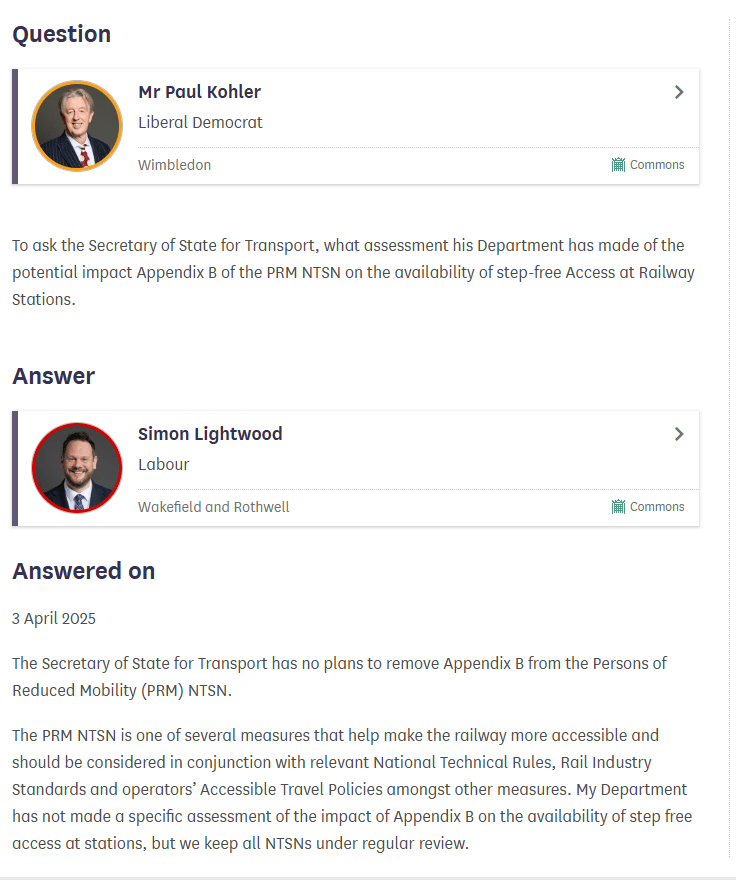
April 2025 – The Secretary of State for Transport confirms via Simon Lightwood MP in a written question that they have no intention of removing Appendix B from the Persons of Restricted Mobility National Technical Notice – even though they admit that they haven’t actually assessed the impact of this appendix on the availability of step-free access at UK railway stations. Quite some admission.
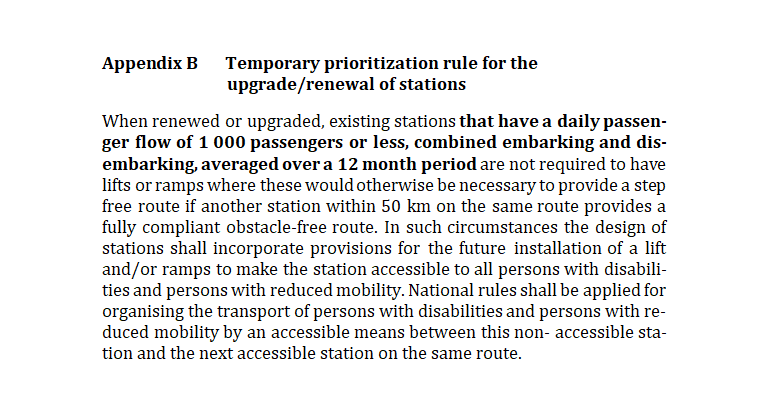
I have written previously about ‘Appendix B – a link is provided in the ‘further reading’ section at the bottom of this blog, which removes any requirement for stations with a daily footfall of less than 1,000 passengers a day and an accessible station within 50km to be made accessible via lifts or ramps. For clarity, only around 980 of the 2,500+ stations exceed this level of passenger flow; therefore, Appendix B becomes a benchmark for inaction. Harlington station in Bedfordshire is just one example of a station that has been impacted by this appendix. I am pretty sure that if MPs had to travel 50km every day to get to their nearest station, they would pull out all the stops to fix the issue.
August 2025 – Lord Hendy confirms that the feasibility studies on the 50 stations had been completed. The source of this is from a Westminster Hall debate on Rural Railway Stations Step Free Access on 11th November 2025 – Helen Morgan MP.
5th November 2025 – The Department for Transport publishes its ‘Accessibility Roadmap’, committing £370 million to Access for All projects.
11th November 2025 – Simon Lightwood MP says in A Westminster Hall debate: “Members representing the other 49 stations are keen to understand the next steps. I thank them for their patience while we carefully consider these important matters (the 50 stations), and I can confirm that we plan to provide that information in the coming months.”
12th November 2025 – We received the clearest indication yet of the government’s direction of travel when it comes to rail accessibility improvements. The relevant excerpt from the Transport Committee oral evidence session from the Secretary of State for Transport is shown below.
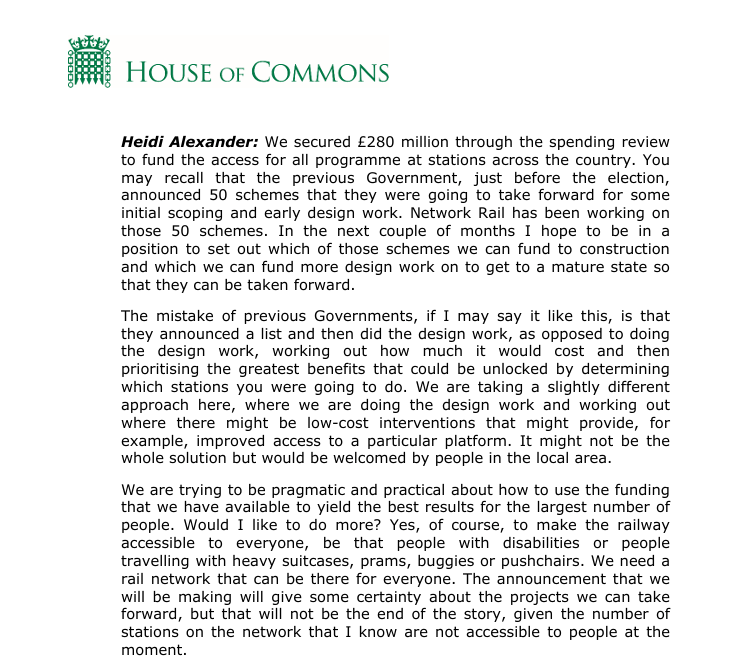
There is quite a lot to pick apart from this. An announcement is, sort of, promised in the ‘next couple of months’, but then there is a clear indication that some of these 50 will be funded to construction, but others will just receive funding for “more design work” to get into a “mature state”. Some may say this sounds like several station projects will be shunted into the long grass.
There seems to be an indication that the whole ‘Access for All’ nomination process is going to change and the design work will be completed before the nomination process. Having gone through a station nomination process, there is a stringent and lengthy set of criteria to go through (shown below), but my understanding of what is a rather opaque statement is that if the design work proves to be tricky (and therefore more expensive), then a step-free project would be unlikely to proceed. This is putting affordability over accessibility. Further, it is not clear what community involvement there would be in the decision making.

Of further concern is the statement (at the bottom of the second paragraph) that funding could be provided to improve access to a single platform on a station, while admitting it wouldn’t be the “whole solution”. This seems to completely miss the point that a partially accessible station is not really accessible at all. To put it in the simplest terms, if you travel from a station, you will, in the vast majority of cases, return on an opposite platform and therefore be on the ‘wrong’ side of the station.
The ‘Accessibility Roadmap’ isn’t really a road map at all. The level of funding will merely bake in the glacial rate of accessibility improvements under the previous government, and communities across the UK will remain completely in the dark about when their station will become accessible.
It has now been 571 days since the previous government announced the 50 stations.
Even if the Labour government were to announce that all 50 stations were to proceed, which seems very unlikely from what they have said to date, it would not change the dial on the rate of accessibility improvements. Apart from the muddled thinking and unacceptable delay in making decisions, I sense an overwhelming lack of any sense of urgency or genuine commitment to providing a step-free rail network. Disabled people have had enough of warm words; it is action they need.
Keir Starmer was correct, accessibility is a basic right, but there seems little chance of this right being achieved on our rail network unless there is a fundamental change of direction. The government’s timidity on rail access just confirms that, for all they may deny it, is that they view accessibility as a favour, not as a right.
Julian Vaughan
Chair Bedfordshire Rail Access Network
5th December 2025
Further Reading:
Step Free and Appendix B: https://julianvaughan.blog/2024/11/15/step-free-and-appendix-b/
The Future for Rail Accessibility: https://julianvaughan.blog/2025/03/28/the-future-for-rail-accessibility/
Rural Stations Step Free Access Westminster Hall Debate 11th November 2025: https://hansard.parliament.uk/Commons/2025-11-11/debates/95279B10-5B37-4D9E-9664-45DCEA6B59EC/RuralRailwayStationsStepFreeAccess?
 Julian Vaughan